Viajé a Bodø con la ilusión de ver un partido de futbol épico, en una latitud donde es improbable que se juegue, y mucho menos con tan buen nivel. La sorpresa me la llevé cuando descubrí que su impresionante riqueza natural es aún mejor que su equipo deportivo.
Como si se tratase de un acertijo nórdico-mágico, en Bodø la percepción del tiempo no está delimitada por la presencia o ausencia de luz solar. En invierno, la penumbra es perenne y cubre con su manto estelar cada ángulo del paisaje desafiando absolutamente la alarma del reloj para despertar; en verano, el Sol encanta e ilumina incesantemente cada rincón del paisaje convirtiendo a la ‘noche’ en un mero tecnicismo horario.
En Bodø, Noruega, la aventura del Círculo Polar Ártico comienza. Una pequeña ciudad nórdica que llamó mi atención por su equipo de futbol, y que me enamoró por su naturaleza. Está relativamente aislada, pues para llegar hacen faltan muchas, muchas horas en coche, un vuelo de noventa minutos o dieciocho horas en tren desde Oslo. La ciudad de poco más de cincuenta mil habitantes sufrió, como pocas urbes noruegas, los estragos de la Segunda Guerra Mundial, cuando fue destruida casi por completo; sin embargo, hoy, ha resurgido como un enclave vibrante, con una oferta cultural y gastronómica que desafía su propia geografía.
Un poco de contexto: Se escucha muy rimbombante “Círculo Polar Ártico” pero es la forma de explicar, a través de una línea imaginaria (sólo se puede ver en los mapas), aquellos lugares donde la luz y la oscuridad se apoderan de las horas debido a la inclinación de la Tierra. La noche polar es cuando el Sol se esconde debajo del horizonte durante un período largo, semanas o meses, depende de la latitud. En verano, el fenómeno natural es el contrario, el sol de medianoche ilumina permanentemente. La temperatura no es tan extrema como su lugar en el mapa lo hace parecer, aunque los fuertes vientos desploman la sensación térmica, especialmente cuando el termómetro ronda los -3°C; en los meses de “calor” el medidor llega hasta 16°C.
La primera aventura comenzó alrededor de las 10 de la mañana, no porque no sea madrugador (que no lo soy), sino porque es mediados de enero y apenas hay un dejo de luz solar, sólo durará alrededor de cinco horas. Tiempo suficiente para alejarse de la ciudad y meterse en el bosque… pero antes, una parada muy especial: Saltstraumen, probablemente el fenómeno natural más icónico de la región y del que me hablaron mucho antes de viajar. Trepados en la camioneta, con gruesas chamarras y botas para aguantar el frío, Esten, el guía de Rampen, me platicaba de la naturaleza alrededor de Bodø y cómo cambia con las estaciones del año. Platicamos acerca del cliché –quizás ineludible– de vikingos y trols, y fue ahí cuando me sorprendió con un dato que terminó de convencerme (como si en realidad lo necesitara) de ir a ver la famosa corriente de marea más fuerte del mundo, y es que tiene tanta fuerza que incluso a los marinos vikingos más habilidosos se les complicaba cruzar el estrecho.
El fenómeno sucede cada seis horas cuando la marea cambia de sentido y se mueve entre los fiordos, en el caso particular de Saltstraumen, el estrecho tiene 150 metros de ancho –pequeño para tantos millones de litros de agua– y forma una especie de cuello de botella que genera remolinos fortísimos y rapidísimos cada que el agua entra y sale del desfiladero natural. La corriente de marea promedia 13 kilómetros por hora, pero en su punto más alto alcanza hasta 37.
El tamborileo del agua se escucha hasta la orilla, desde donde se puede observar la vorágine de los numerosos espirales arrítmicos. La zona es también famosa por la fauna diversa que la habita tanto debajo como por encima del agua: bacalaos, fletanes y abadejos son algunos de los peces que revolotean con la corriente, a veces incautos de las cuantiosas águilas marinas de cola blanca que los acechan desde arriba; también hay cuantiosos eíderes (una especia de pato), cormoranes y gaviotas flotando. La velocidad de la corriente toma dimensión vista desde algunos miradores a los costados del estrecho; desde el puente que lo cruza, los hipnotizantes remolinos toman forma. Por si eso fuera poco, el panorama luce incoloro porque la vastedad blanca es inagotable: cielo nublado y una gruesa capa de nieve cubriendo cualquier dejo de tierra.
Después de un largo rato magnetizado con el fenómeno de Saltstraumen, avanzamos algunos minutos más en la van para encontrarnos inmersos en el bosque. Tiempo de snowshoeing. Con raquetas de nieve puestas en las botas, caminamos por el sendero que lleva hacia Valnesfossen, la cascada más alta de Bodø. La vereda tiene de todo: ligeras pendientes entre árboles frondosos, lagos congelados (solo cuando es invierno) y riachuelos discretos. A la mitad del camino hay una guarida hecha de madera para tomar un descanso o refugiarse de la lluvia. Ahí, Esten me consintió con un chocolate caliente y una tertulia muy agradable; un detalle singular que da identidad a las expediciones de Rampen.
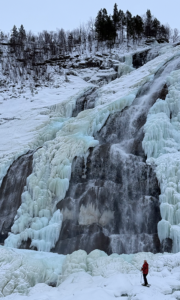
Luego de cruzar un lago congelado y evadir algunas rocas truculentas, el estruendo del chorro de agua se escuchó más fuerte, después la inmensa cascada se asomó enfrente. Conforme nos acercamos al gélido torrente descubrí que el aire es tan limpio y se siente tan fresco, como si todo el tiempo tuviéramos una pastilla de menta intensa en la boca. Un deleite para el olfato. La caída en Valnesfossen es de 60 metros, pero su forma es curva, así que, vista desde donde comienza el arroyo que se forma abajo, no se alcanza a ver la parte más alta. En invierno, hay algunos pilares de agua que lucen congelados, sobre todo donde se asoman rocas y acumulan algunas plantas. El regreso al punto de entrada puede ser por un camino más sencillo, donde no necesita destreza física, pero quería que el camino de regreso a la camioneta se hiciera largo para seguir disfrutando del aire fresco y la tranquilidad del bosque.
Los locales recomiendan que, en la medida de lo posible, se realice la búsqueda de auroras boreales el mismo día que se visita la cascada, como una especie de maridaje de aventuras en el entorno del ártico. Luego de unas horas, cuando ya no había luz solar, entonces llegó el turno de la noche y su colorida magia. En punto de las siete de la noche nos reunimos en el Rampen Adventure Hub en el centro de Bodø y arrancamos el safari de las luces del norte, esta vez, sin un destino fijo, pues Esten –nuevamente nuestro guía–, mencionó que encontrar dónde apreciarlas mejor depende de alejarnos lo más posible de las luces urbanas, y después, espacios abiertos, tal vez en una bahía o al pie de una montaña. Eso sí, como todo en la naturaleza, también se necesita suerte.
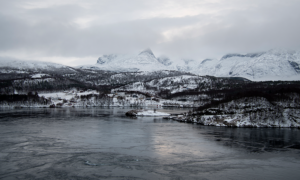
En la carretera ya estaba ansioso, pues desde la ventana de la camioneta se podían ver algunos tonos verdosos “opacando” las estrellas; no quería que desaparecieran antes de que llegáramos. Cuarenta y cinco minutos pasaron hasta que finalmente encontramos un lugar entre dos montañas y una pequeña entrada al mar, o al menos eso es lo que parecía con la poca luz que había.
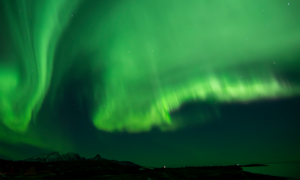
Y entonces sí, el cielo absolutamente despejado, estrellas brillantes espolvoreadas por doquier y estelas amarillentas, esmeraldas y verde limón se contoneaban sobre nosotros. Auroras Boreales danzaron iluminando todo el lugar como si hubiese luna llena, el movimiento arrítmico de sus cortinas y los aros que se contraían me dejaron completamente embelesado, tanto que dejé la cámara a un lado para sólo disfrutarlas. El tiempo voló. Antes de irnos, Esten volvió a consentirnos con chocolate caliente y café, para calentar el cuerpo, pues el alma ya estaba teñida con las luces celestiales.
Bodø y el Círculo Polar Ártico tienen otras sorpresas inesperadas como su amplia oferta gastronómica, el museo de aviación, el muelle o la sauna Pust para relajarse un rato…, pero eso es otra historia. Bodø/Glimt y su cuento de hadas balompédico puso a la ciudad en el mapa para mucha gente, pero vaya que la naturaleza y la calidez de su gente son lo que más cautivan.
I travelled to Bodø with the dream of seeing an epic football match in a latitude where it is unlikely to be played, let alone at such a high level. The surprise came when I discovered that its impressive natural wealth is even better than its sports team.
As if it were a Nordic-magical riddle, in Bodø, the perception of time is not delimited by the presence or absence of sunlight. In winter, the twilight is perennial, covering every angle of the landscape with its stellar mantle and absolutely challenging the alarm clock’s call to wake up; in summer, the Sun enchants and illuminates every corner of the landscape incessantly, turning ‘night’ into a mere horary technicality.
In Bodø, Norway, the Arctic Circle adventure begins. This small Nordic city first caught my attention because of its football team, but I fell in love with it for its nature. It is relatively isolated; reaching it requires many, many hours by car, a ninety-minute flight, or an eighteen-hour train journey from Oslo. This city of just over fifty thousand inhabitants suffered, like few Norwegian urban centres, the ravages of the Second World War, when it was almost completely destroyed; however, today it has re-emerged as a vibrant enclave with a cultural and gastronomic offering that defies its own geography.
To provide a bit of context: “Arctic Circle” sounds very grand, but it is a way of explaining, through an imaginary line (only visible on maps), those places where light and darkness take over the hours due to the Earth’s tilt. The polar night occurs when the Sun hides below the horizon for a long period—weeks or months, depending on the latitude. In summer, the natural phenomenon is the opposite: the midnight sun shines permanently. The temperature is not as extreme as its place on the map makes it seem, although strong winds cause the wind chill to plummet, especially when the thermometer hovers around -3°C; in the “warm” months, the gauge reaches 16°C.
The Force of Saltstraumen
The first adventure began around 10 am—not because I am an early riser (which I am not), but because it is mid-January and there is barely a hint of sunlight, which will only last about five hours. This is enough time to get away from the city and head into the forest… but first, a very special stop: Saltstraumen, probably the most iconic natural phenomenon in the region and one I had heard much about before travelling. Already in the van, wearing thick jackets and boots to withstand the cold, Esten, the guide from Rampen, told me about the nature around Bodø and how it changes with the seasons. We chatted about the—perhaps inescapable—cliché of Vikings and trolls, and it was then that he surprised me with a fact that finally convinced me (as if I actually needed it) to go and see the world’s strongest tidal current: it has so much force that even the most skilled Viking sailors found it difficult to cross the strait.
The phenomenon occurs every six hours when the tide changes direction and moves between the fjords. In the specific case of Saltstraumen, the strait is 150 metres wide—small for so many millions of litres of water—forming a kind of bottleneck that generates extremely strong and fast whirlpools every time the water enters and leaves the natural gorge. The tidal current averages 13 km/h, but at its peak, it reaches up to 37 km/h.
The drumming of the water can be heard from the shore, where one can observe the maelstrom of numerous arrhythmic spirals. The area is also famous for the diverse fauna that inhabits it both below and above the water: cod, halibut, and pollack are some of the fish that flit about in the current, sometimes unaware of the numerous white-tailed sea eagles stalking them from above; there are also many eiders (a type of duck), cormorants, and gulls floating nearby. The speed of the current takes on a new dimension when viewed from viewpoints at the sides of the strait; from the bridge that crosses it, the mesmerising whirlpools take shape. To top it off, the panorama looks colourless because the white vastness is inexhaustible: a cloudy sky and a thick layer of snow covering any hint of earth.
Snowshoeing to Valnesfossen
After a long time magnetised by the Saltstraumen phenomenon, we drove a few minutes further in the van to find ourselves immersed in the forest. Time for snowshoeing. With snowshoes fitted to our boots, we walked along the path leading to Valnesfossen, the highest waterfall in Bodø. The trail has everything: gentle slopes between leafy trees, frozen lakes (only in winter), and discreet streams. Halfway there, there is a wooden shelter to take a break or take refuge from the rain. There, Esten treated me to a hot chocolate and a very pleasant chat—a singular detail that gives identity to Rampen’s expeditions.
After crossing a frozen lake and evading some tricky rocks, the roar of the water jet grew louder, and then the immense waterfall appeared ahead. As we approached the icy torrent, I discovered that the air is so clean and feels so fresh, as if we had an intense mint lozenge in our mouths the whole time. It is a delight for the sense of smell. The drop at Valnesfossen is 60 metres, but its shape is curved, so, seen from where the stream begins below, the highest part cannot be seen. In winter, there are some pillars of water that appear frozen, especially where rocks protrude and plants accumulate. The return to the entrance point can be via a simpler path that requires no physical skill, but I wanted the walk back to the van to be long so I could continue enjoying the fresh air and the tranquility of the forest.
The Dance of the Northern Lights
Locals recommend that, whenever possible, the search for the Northern Lights should be carried out on the same day as the waterfall visit, as a kind of adventure pairing in the Arctic environment. After a few hours, when there was no longer any sunlight, it was the night’s turn and its colourful magic.
At seven o’clock sharp, we met at the Rampen Adventure Hub in the centre of Bodø and started the Northern Lights safari. This time, there was no fixed destination, as Esten—our guide again—mentioned that finding the best place to appreciate them depends on getting as far away as possible from urban lights, followed by open spaces, perhaps in a bay or at the foot of a mountain. Of course, like everything in nature, luck is also needed.
On the road, I was already anxious, as greenish tones could be seen from the van window “overshadowing” the stars; I didn’t want them to disappear before we arrived. Forty-five minutes passed until we finally found a place between two mountains and a small inlet to the sea—or at least that’s what it seemed like with the little light there was.
And then, indeed, the sky was absolutely clear, bright stars were sprinkled everywhere, and trails of yellow, emerald, and lime green swayed above us. The Northern Lights danced, illuminating the whole place as if there were a full moon. The arrhythmic movement of their curtains and the contracting rings left me completely spellbound, so much so that I put the camera aside just to enjoy them. Time flew. Before leaving, Esten treated us again to hot chocolate and coffee to warm the body, for the soul was already tinted with the celestial lights.
Bodø and the Arctic Circle have other unexpected surprises, such as their wide gastronomic offering, the aviation museum, the pier, or the Pust sauna for a bit of relaxation… but that is another story. Bodø/Glimt and its footballing fairytale put the city on the map for many people, but nature and the warmth of its people are truly what captivate the most.
Recomendaciones para tu visita a Bodø:
- Actividades:
- Rampen: Aventuras en la naturaleza del ártico noruego: Snowshoeing (caminata con raquetas de nieve), recorridos en motonieve, rapel, tour en bote por Salstraumen (pequeño estrecho conocido por tener la corriente de marea más fuerte del mundo o el afamado Safari Auroras Boreales.
- Dirección: Rampen Adventure Hub, Sjøgata 41, Bodø, Noruega
- Contacto: +47 75 57 74 77 / hello@ rampen
- Web: https://www.rampen.com/en
- Rampen: Aventuras en la naturaleza del ártico noruego: Snowshoeing (caminata con raquetas de nieve), recorridos en motonieve, rapel, tour en bote por Salstraumen (pequeño estrecho conocido por tener la corriente de marea más fuerte del mundo o el afamado Safari Auroras Boreales.
- Hospedaje:
- Scandic Havet, ubicado en el centro de la ciudad, a unos metros del muelle.
- Dirección: Tollbugaten 5, Bodø, Noruega
- Contacto: +47 75 50 38 00 / [email protected]
- Web: https://scandichotels.com/
- MS Salten, un histórico buque costero atracado en el puerto ofrece una experiencia marítima única en pleno centro de la ciudad.
- SmartHotel Bodø, un hotel cómodo que combina las virtudes de la hotelería convencional y las magia de la tecnología.
- Web: https://smarthotel.no/no/bodo
- Scandic Havet, ubicado en el centro de la ciudad, a unos metros del muelle.
- Oficinas de turismo:
- Visit Bodø – visitbodo.com
- Instagram, TikTok and LinkedIn: @visitbodo
- Facebook: Visit Bodø
- Northern Norway Tourist Board – https://nordnorge.com/
- Instagram: @northernnorway
- Facebook: Visit Northern Norway
- Action Now: https://www.actionnow.no/
- Visit Bodø – visitbodo.com
Nota: Esta cobertura fue posible gracias al apoyo de Northern Norway Tourist Board, Visit Bodø y Rampen Tours.
- Actividades:
- Rampen: Adventures in the Norwegian Arctic nature: Snowshoeing, snowmobile tours, abseiling, boat tours of Saltstraumen (the small strait known for having the world’s strongest tidal current), or the famed Northern Lights Safari.
- Dirección: Rampen Adventure Hub, Sjøgata 41, Bodø, Noruega
- Contacto: +47 75 57 74 77 / hello@ rampen
- Web: https://www.rampen.com/en
- Rampen: Adventures in the Norwegian Arctic nature: Snowshoeing, snowmobile tours, abseiling, boat tours of Saltstraumen (the small strait known for having the world’s strongest tidal current), or the famed Northern Lights Safari.
- Accommodation:
- Scandic Havet, Located in the city centre, a few metres from the pier..
- Dirección: Tollbugaten 5, Bodø, Noruega
- Contacto: +47 75 50 38 00 / [email protected]
- Web: https://scandichotels.com/
- MS Salten, A historic coastal vessel docked in the port offers a unique maritime experience in the heart of the city centre.
- SmartHotel Bodø, A comfortable hotel that combines the virtues of conventional hospitality with the magic of technology.
- Web: https://smarthotel.no/no/bodo
- Scandic Havet, Located in the city centre, a few metres from the pier..
- Tourism Offices:
- Visit Bodø – visitbodo.com
- Instagram, TikTok and LinkedIn: @visitbodo
- Facebook: Visit Bodø
- Northern Norway Tourist Board – https://nordnorge.com/
- Instagram: @northernnorway
- Facebook: Visit Northern Norway
- Action Now: https://www.actionnow.no/
- Visit Bodø – visitbodo.com
Note: This coverage was made possible with the support of the Northern Norway Tourist Board, Visit Bodø, and Rampen Tours.